
Communication is about more than imparting information. You’re hoping to show yourself as a particular kind of person. You’re also trying to influence people. You also use language to build and maintain good relationships. Our communication is doing quite a lot of work for us, and it can be easy to forget this.
There is a way to break down some of the most important elements of communication that’s been used, mostly unchanged, since ancient times. Its value is in helping us look at each element, individually. This was, we can see where we are–and aren’t–living up to our own goals for our communication. This is true whether we’re talking, scanning social media, creating a video, or any other use of words and image.
You may have seen something called the rhetorical triangle. This is typically the three elements first identified by Aristotle as central to spoken communication: audience, speaker, message. These are also sometimes shown as logos, ethos, and pathos. These three elements, Aristotle argued, are the basis of a formal conversation. Frequently, that triangle is pictured with a circle around it. That circle portrays context, and mode.
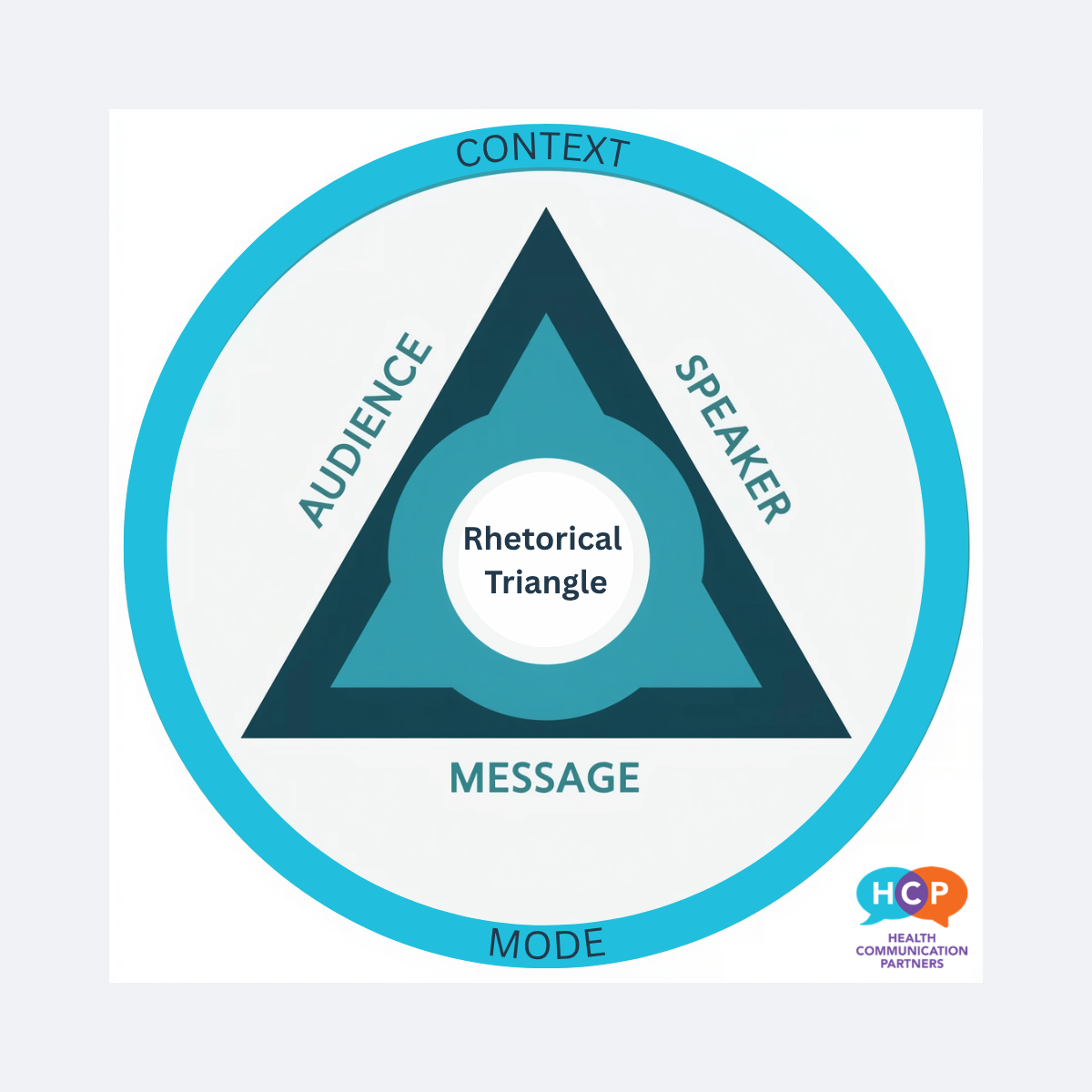
Briefly, here’s what each of those means.
| Speaker | Who’s talking, writing, producing |
| Audience | Who’s listening, reading, viewing, consuming |
| Message | The content and purpose of the communication |
| Context | There are many contexts around any given communication. Time, space, cultural, economic, political, social, emotional, linguistic, etc. |
| Mode | The form, channel or way meaning is communicated. Speech, written text, graphics, video, signs, etc. Any combination of modes is called ‘multimodal’ |
Each of these 5 elements matters in communication, separately and together. With these 5 elements in mind, you can break down any spoken communication. I’ll show you how.
First, pay attention to someone else. An easy way to begin to see how these 5 rhetorical elements work is to focus on someone else’s communication. I would suggest someone famous who does talking for a living. The next time you listen to a radio personality, someone on a talk show, news anchor, your favorite podcaster, think of the 5 elements. Speaker, audience, message, context, mode.
Then, try out these questions:
- Who does this speaker think he/she is? How does their language reveal this?
- Who do they think you are? How can you tell through their language?
- What do you think their central message is? What did they say that reveals this?
- What is their attitude toward a particular context they’re in? How can you tell? (Time can be an easy one to spot, or the political/economic/social climate).
Thinking about these questions gives you a sense how these 5 elements can help you break down a spoken communication.
This quick sort of mental checklist allows you to assess the most important factors of any communication, even during or after your conversation. The focus is on becoming aware of your language in relation to each of these important factors.
Clear communication builds trust and improves outcomes. I partner with healthcare and public health teams to strengthen communication in ways that are practical and sustainable. If your organization is ready to take a more intentional approach, I’d love to work with you. Just fill out the form below.
