
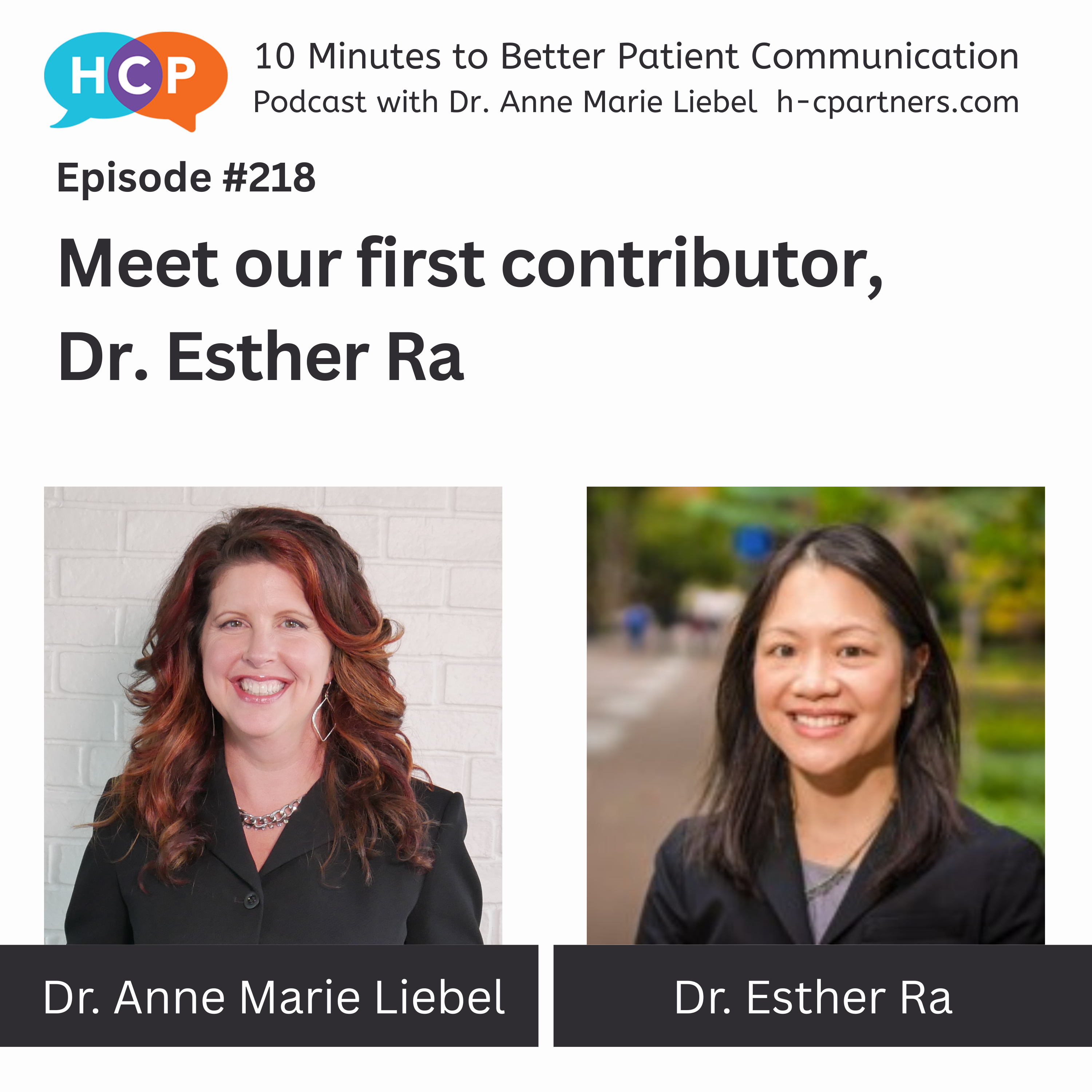

Welcome to a new year, and a new chapter for the show. We’re starting a new collaboration and I couldn’t be happier about it. I’m thrilled to welcome Dr. Esther Ra to the show, as a new voice contributing her expertise on communication across professions and across the world.
Hi, everybody. This is 10 Minutes to Better Patient Communication from Health Communication Partners. Since 2017, we’ve been giving you inspiration and strategies to improve engagement, experience, and satisfaction. I’m Dr. Anne Marie Liebel, a researcher, consultant, and educator specializing in communication and education. This series unpacks what often goes unnoticed in how we communicate at work. We shine some light on habits and assumptions we can take for granted when we communicate, especially in health care and public health, but increasingly across sectors because communication touches everything. We’re here to learn, get inspired, and most importantly, make the difference we got into our jobs to make.
And we’re kicking off the new year! And the show is growing! And I’m thrilled to introduce someone who’s going to be here for a run of episodes to start this new year: Dr. Esther Ra. She adds expertise and insight and a global dimension that I’ve been really eager to bring to the show. I can’t think of a better moment to expand what we’re doing here.
Now, I want to tell you a little bit about Dr. Ra. She owns her own coaching practice as a career and executive coach. She specializes in intercultural communication in business. She’s also a lecturer at the Wharton School and has been working in career development at the University of Pennsylvania, specializing in co -leading the international committeee. SHe’s also had the pleasure of being invited to serve as Visiting Professor at Seoul National University in South Korea, teaching business communications for global careers. I was lucky enough to meet Esther in grad school. , so we’ve known each other for a long time. We both went to Penn GSE, we both have our degrees in language, literacy, and education. And we’ve both applied this research that we learned there in different ways, in fields that are far from the classrooms that we both came from.
So Dr. Ra is going to be contributing on a few episodes, continuing the focus on health care and public health, but also occasionally touching on other professional groups. Dr. Ra has different stories, her global perspective, hopefully we can do some topics that I haven’t explored before. So Dr. Ra, welcome to the show!
Thank you so much, Anne Marie. Such a pleasure to be here. And thanks for inviting me.
I’m so glad that you’re here. And I feel like it’s kind of a natural place for us to start. Like, why are we both on a podcast about communication in health care and public health? Years and years and years after graduating from graduate school at Penn GSE, being educators and being former classroom teachers. Why are we here now?
Yes, I mean, who would have thought, right?
Right.?
Yes, you’re right. We both came from classrooms and we were classroom teachers and then we both got our doctorates and now we’re both in the fields of communications. And it’s it’s quite amazing the steps we’ve taken to be where we respectively are and the work we’re both doing to impact the folks around us.
It’s because there’s so much that we learned that’s transferrable. It feels like that’s been a lot of what–the reason I starteed this show 8 years ago was because there’s a whole lot of need for some of what we know about language and learning and literacy that could be applicable in the health sector. But, you know, academic silos are real. And the research and the science from one sector doesn’t always make it over to another sector. So that was the reason I started this show. And that’s how I’ve been using another research that we came from. How about you? What have you been up to using some of the research that we all learned at GSE?
Yeah. Yeah. It’s so true, Anne Marie. We both came from academia, many years ago when we were in the doctoral classroom. And now, I’ve been working in career development and I have been lecturing in the classroom, business classrooms and also overseas over at Seoul National. I also taught at Korea University too. And I now own my own coaching practice. And what I have found in working with folks is that so many of them struggle with conveying their thoughts or delivering things in a way that is meaningful, and that lands well for their audience. And so, there are so many elements to communications, but working with folks across many sectors and businesses and fields, really, industries, it’s been a learning process for me too and something that i really enjoy coaching on and learning alongside folks.
And that’s been my experience, how exciting it is to learn from people who care about communication and people who know that communciation is important in their jobs. and that communication is a way to, you know, make things happen, get things done, right? It gets called a soft skill, but I don’t know. I think that’s kind of like, that’s not a very accurate way to think about it. This is hard!
Yes. I actually, it is, there’s research that says that, many people dismiss it because they think of it as a soft skill. But when thinking about this so-called soft skill, it has really hard consequences if you don’t have them, if you don’t have these skills. Global research from Towers Watson has found that organizations with highly effective internal communications are three and a half times more likely to out-perform their peers. For health care leaders, this is especially relevant, and the stakes are much higher because the measurement and the value is beyond monetary value, which we know is very true in all businesses. But in health care, that clear and consistent communication is really needed to strengthen care coordination, reduce error, promote safety, improve staff engagement, mitigate turnover, and accelerate operational performance. So investing in this quote-unquote soft skill, it’s a really strategic driver in quality, safety, and return on investment.
So you’ve had a variety of experiences with people on the front lines, different professions, working with communication. What are you excited to bring to this show?
One thing you and I have talked a lot about is empathy, and I would love to talk about that more and delve into that. I think that’s a really interesting topic in relation to communications.
And over eight years of the show, I have not done a single episode about empathy! So I’m really glad to hear that. And I think our
listeners will be glad to hear that too. So I’m so glad, Esther, that you’re great to my invitation to contribute to the show now and again. Maybe we can be on mic together again! Maybe you’ll take an episode on your own. And I’m just delighted that you are here and that I can learn from you and that our audience can learn from you, as we take this new chapter together. And thank you for making this
collaboration–this is one i have been looking forward to–so thank you for making it easy and fun for me too.
Thank you Anne Marie, it’s it’s been such a pleasure! And you know, you know you and i can talk about these things right?
100% right?! I think the trouble is going to be like, okay, keep it to 10 minutes! So let me wrap it up here! This has been 10 Minutes to Better Patient Communication from Health Communication Partners, audio engineering and music from Joe Lebel, additional music from Alexis Rounds. Thanks for listening to 10 Minutes to Better Patient Communication from Health Communication Partners LLC. Find us at healthcommunicationpartners .com.