
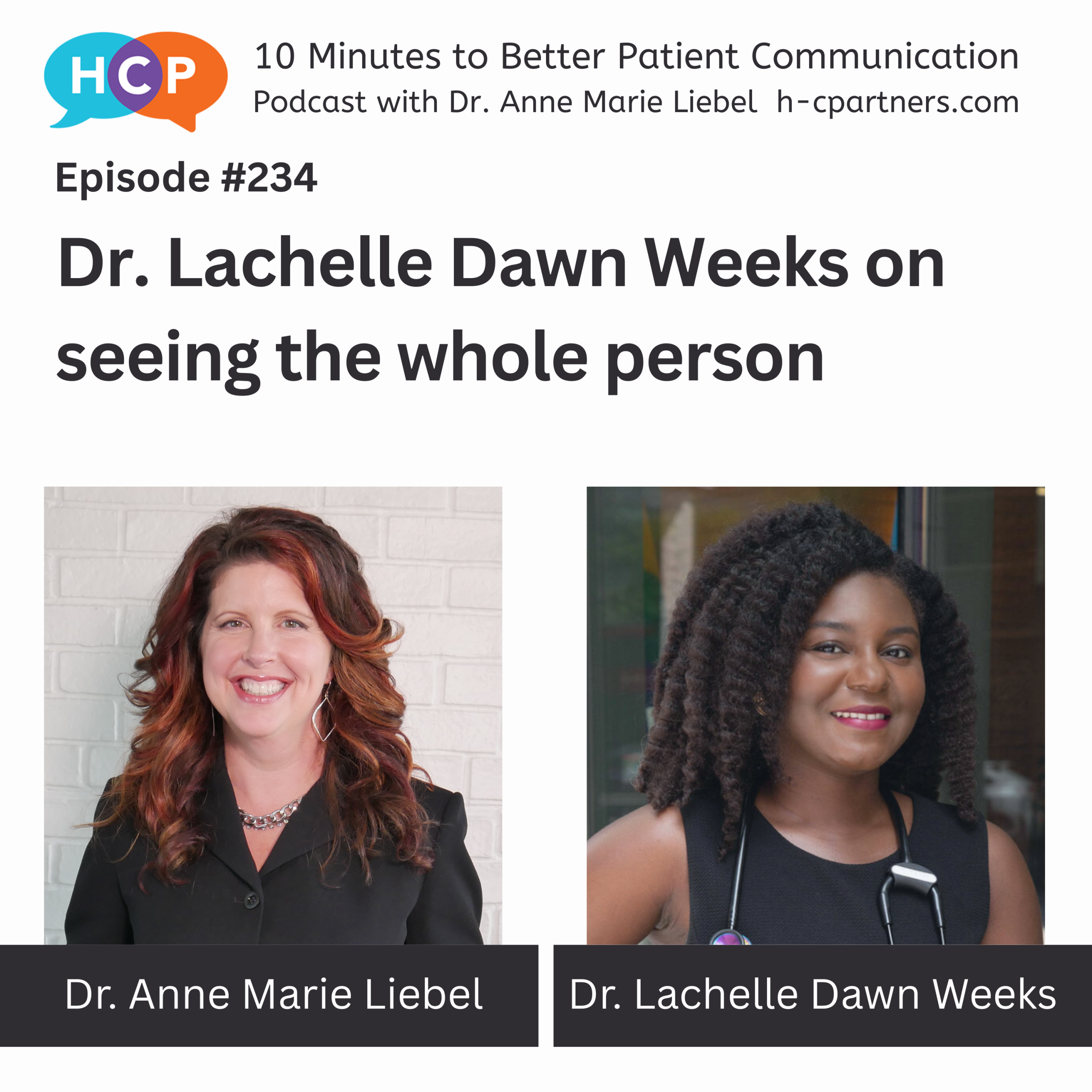

Dr. Lachelle Dawn Weeks, MD, PhD is a hematologist at Dana-Farber Cancer Institute. She directs the Dana-Farber CHIP Clinic and is the principal investigator of The Weeks Lab.
Dr. Weeks is among the less than 2% of hematologists who are Black women. So over the last couple of years, she has made a decision to show up as her whole self, usually as the only Black woman in the space. Dr. Weeks talks about clinicians showing up whole, seeing a patient as a whole person, and how wholeness makes for better patient communication.
Words like patient or provider describe a function someone’s performing, not who they actually are. Hematologist Dr. Lachelle Dawn Weeks describes the dangers of sorting people into categories and how she reclaims context and a sense of humanity.
Hi, everybody. This is 10 Minutes to Better Patient Communication from Health Communication Partners. Since 2017, we’ve been giving you inspiration and strategies to improve engagement, experience, and satisfaction. I’m Dr. Anne Marie Liebel, a researcher, consultant, and educator specializing in communication and education. This podcast makes space to dig into what it’s easy to take for granted about communication in our professional lives, especially in healthcare and public health, but increasingly across sectors because communication touches everything. We’re here to learn and get inspired, but most importantly, make the difference we got into our jobs to make. I help organizations act with clarity and confidence in complex, high-stakes situations. I’m currently booking consulting clients. You can work with me. Reach me on LinkedIn, on Instagram at Health Communication Partners, or at healthcommunicationpartners.com.
Yeah, healthcare is famous for putting labels on people, patient, subject, physician, academic. Once that happens, it’s easy for us to respond to the label along with the person. This kind of compartmentalizing is what Dr. Weeks talks about today. It’s not a personal failing as much as it’s a structural problem. Our organizations encourage us to label people. And that in itself isn’t problematic, but it can be if the label becomes a lens through which we see people and we’re not really aware of it.
So today I’m replaying an interview with hematologist Dr. Weeks, who talks about this tendency in healthcare to lose sight of the whole person. She tells us how she’s managed this pressure in her career and about the value of reclaiming wholeness in the healthcare setting. Here’s Dr. Weeks.
Can you tell our audience a little bit about yourself, what you do?
So I am a fellow at Dana-Farber, so I’m a hematology fellow. I do a combination of research and patient care, studying leukemia and precursor conditions to leukemias.
Can you tell me one of the communication issues that’s on your mind these days?
Yeah! So I have been thinking a lot about the concept of wholeness. And the concept of how we communicate who our patients are and who we are to each other within the hospital space. And just to sort of expand on that a little bit more, I think there’s a tendency in medicine and Academia to think of Physicians as these sort of heroic healers, and academicians as this sort of, you know, machine that sort of spitting out scholarship as a commodity. And then patients as either bags of medical problems, or research subjects, if they happen to be on a clinical trial. And we sort of compartmentalize people in these different ways. And you lose a lot of the background and the context that sort of explains how people get to the positions that they’re in, and why they feel the way that they do once they’re in those positions. And so i’ve been thinking a lot about how to show up whole! How to look at the patient and see the whole person, instead of seeing just the parts that are being presented to me.
That’s a lot! I mean that the idea of wholeness. But I really appreciate that you’re talking about it not just of the patient side—‘cause we can we hear about, you know, patient-centeredness, talking about the whole person and that’s definitely a discourse that’s out there that’s great. But you’re also talking about the tendency for clinicians and Physicians to also be seen not as full people
How have you been approaching this? What have you been doing around this issue lately? Have you been thinking about it?
Yeah, so you know, I think one of the things that really got me in this space of wanting to show up whole, wanting Physicians, other Physicians, my colleagues, my friends, to be able and feel free to show up whole–is this: the one of the things that I find to be particularly oppressive is this concept of professionalism in medicine. And the concept that there is one way to be professional. That there are certain things that Physicians are supposed to talk about and certain things that they’re not. And in reality, we all show up to our profession–to anywhere we go–with, as collections of our experiences, and things that we’ve seen, people that we’ve known. And to divorce ourselves from those experiences is really artificial. And I think that when we do that, we also build in some dissatisfaction with our career. Because you’re not being your whole self when you show up to spaces.
Is there anything that you’re doing to kind of remember that your patients are whole people too?
Yeah! So in residency I actually did something called social rounds. And this is just something that I decided to do at the end of the day or in the middle of the day when we had some downtime, was just go around and talk to my patients and see who they were. And you know see if they needed anything and check on them. A lot of that work that you do doesn’t happen at the bedside for the patient. It happens in terms of documentation, and sitting at a computer and writing stuff down. And ordering things, and answering pages. And really, you can lose track of the people that you came to work to care for.
So I would just go around and sort of sit and talk to people, and learn about their families. And you know, talk to them about books they had, and things, and things of that nature. Just very human, the human part of medicine!
Yeah yeah absolutely! So what have you been learning? Like what are you learning about your patients or about working with patients? What are you learning about yourself and working with your colleagues?
Yeah, so I, one of the things that I learned through doing that is that everyone–that patients can come to the same decision about a treatment plan, or you know to accept or decline a treatment, but people come to those decisions from different Pathways and avenues.
And so one of the things that having these moments where I communicate with my patients and get to understand their lives and their background, one of the things that it’s helped me with is to tailor my delivery of information to that individual person. To be able to talk to people in language that they understand. Or to put the idea of a therapy and its side effects in the context of you know, “This is what I heard you say your goals were. This is what this particular therapy is going to do, and you know, is this in congruence with what your goals are?” And I think that that is just been very helpful for me in approaching. And something that if I didn’t get to know my patients I wouldn’t be able to have had the conversation in a nuanced way.
Yeah! That’s what I was just thinking but that the impact of this social rounds that you took the time to have ,makes it possible for you to have the kinds of relationships and conversations that you have. That makes a lot of sense.
And I would sort of advise–particularly individuals who are black indigenous other people of color—that, you know, be confident that what you’re bringing to the table matters. Because it matters so much. And it’s with that confidence that I’m able to sort of stand up and say “this is just who I am.” And you know I am all of these parts of myself all the time. And I can’t turn them off even if I wanted to, and I’m not going to try!
It’s clear to me that in giving yourself permission to do that and say that and be that, you’re also allowing your patients permission
Oh absolutely, absolutely
To be them themselves wholly and fully. And you’re hearing them as themselves when you’re doing these social rounds and asking these questions
Right!
Thank you so much for this.
No problem!
Thank you, Doctor Lachelle Dawn Weeks, fellow at Dana-Farber Cancer Institute, thank you for being on the show today!
Thank you so much! This was really great! I really enjoyed it.
