
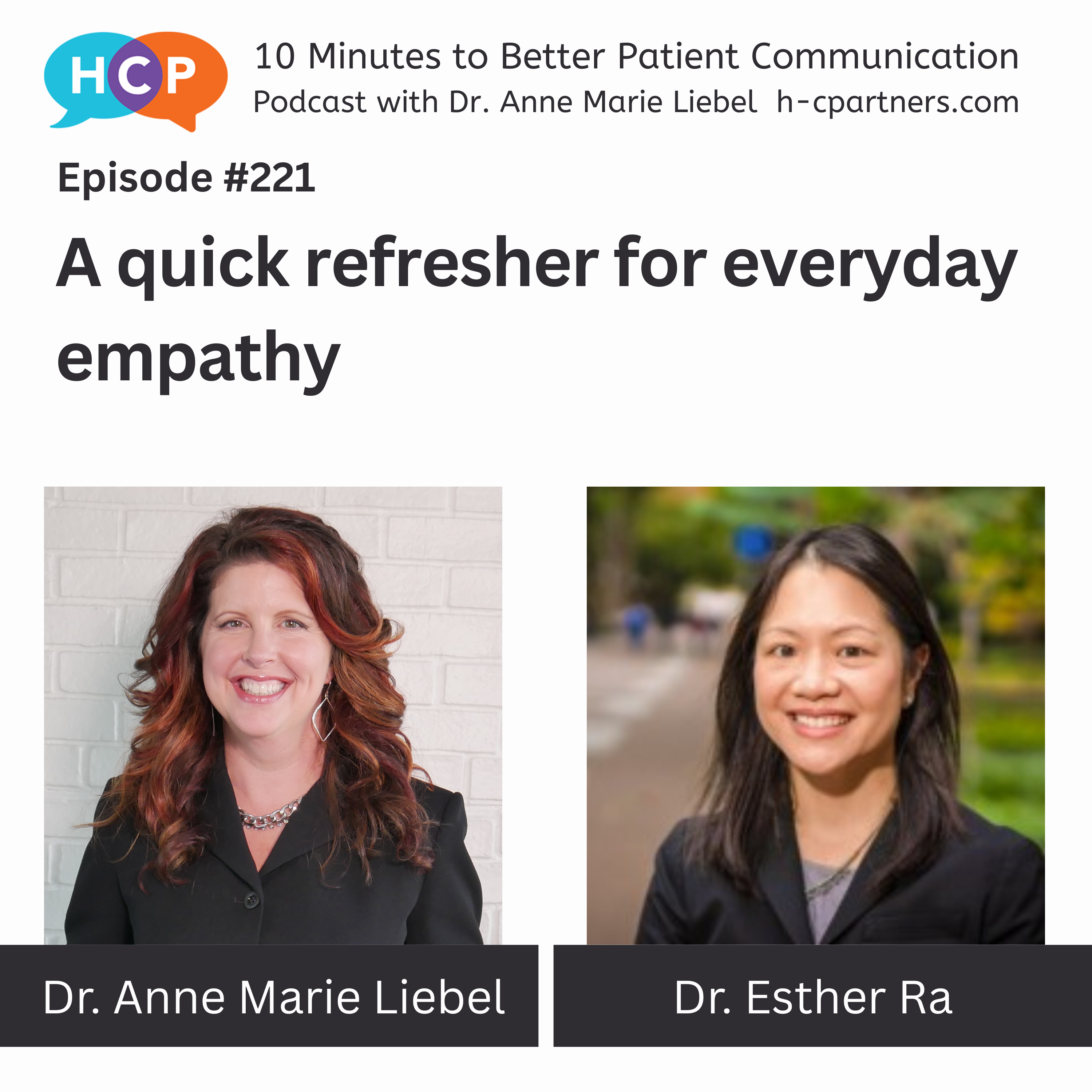

Is it possible to develop strategies to be a better empathizer? Dr. Esther Ra is co-hosting with me today, and we’re talking about empathy. Dr. Ra will share a glimpse at some of the research on empathy in health care, some interesting statistics, and a quick refresher for you. It could be handy right before your next interaction with a patient or client.
Hi, everybody. This is 10 Minutes to Better Patient Communication from Health Communication Partners. Since 2017, we’ve been giving you inspiration and strategies to improve engagement, experience, and satisfaction. I’m Dr. Anne Marie Liebel, a researcher, consultant, and educator specializing in communication and education.
And I’m Dr. Esther Ra, a career and executive leadership coach and consultant who specializes in intercultural communication in business and the workplace.
This podcast makes space to dig into what it’s easy to take for granted about communication in our professional lives, especially in health care and public health, but increasingly across sectors, because communication touches everything. We’re here to learn and get inspired, and most importantly, make the difference we got into our jobs to make.
If you like what you’re hearing, I’ve made something for you. New on HealthCommunicationPartners.com is our Learning Library. It’s a freshly organized way to explore the content you’ve come to rely on. There’s clearer categories, better organization, and a single page you can go to to explore what’s here. Find what you need, when you need it, at healthcommunicationpartners.com.
Esther, welcome back to the show!
Thank you so much. It’s such a pleasure to be here again.
I’m glad you’re here, and everybody, if you didn’t catch our announcement earlier, Dr. Ra is our first contributor to the show. And we’re co-hosting today. We co-hosted an episode earlier this year. And Esther is back today to talk about a topic that is important to her that she has educated on in the past. And it’s empathy. It’s a huge topic that I have not had the bravery to tackle in this show. So Esther, thank you so much for getting us into it. Where would you like to start?
I’d love to define empathy in clinical practice.
All right, let’s do it.
Empathy is a huge topic, as we know, and it’s defined in different ways, and it’s also understood and measured in multiple ways. But the main way that I’d like to frame it for today is: Mercer and Reynolds were researchers who are widely cited in clinical medicine. And they wrote an article in 2002, and their definition stands as “understanding a patient situation, perspective, and feelings to communicate that understanding, and therefore to act therapeutically in acknowledgement on that understanding.” So that’s a, that’s a mouthful.
That’s a mouthful.
It definitely is, and it lends to empathy being a complex set of practices, and it involves several things. It involves listening, communicating, and acting.
Hmm. That helps because when we’ve got something that’s as large and kind of vague set of practices as empathy, it helps to kind of make it concrete. We’re thinking about empathy and listening, empathy and communicating, and empathy than acting. So there’s been a whole lot of research for a couple of decades now on empathy and health care. You want to tell us a little bit about what you’ve noticed over some of the trends lately? (Sending podcast love to our friends at Cleveland Clinic and their excellent series on empathy.)
Yes, there’s been systematic reviews on empathy among healthcare professionals specifically, and their empathy levels. And some interesting facts that I found, and some of these might be known, are that gender is often a predictor of empathy. Women tend to score higher than males on empathy levels. And interestingly, this was one that surprised me, was that married providers also scored higher than unmarried providers.
Huh, that is a little bit surprising, but it’s also like, what about those of us who are single? Like, what does that mean for us as empathizers?
Well, that doesn’t mean that you’re excluded from this at all, and that you definitely have that capacity to develop and to gain strategies towards being a more empathetic provider.
Well, that’s good to hear, because I get nervous when we start defining things and kind of measuring them and having cut scores. Like what happens when you’re on the wrong side of that cut score. So we’re thinking about empathy as something that maybe we’re all born with, but maybe some of us are better at expressing than others?
Absolutely. It’s there are traits that you can definitely develop. And I do think that there are folks that are more inclined to being empathetic. One other interesting fact that I found was that there were no remarkable differences between empathy across health care providers. So whether you were a nurse or a therapist or a doctor or a patient educator or an advocate, it really didn’t show any difference in empathy levels.
And when we’re in helping professions, it would seem that we’re kind of: empathy is important. Empathy is important in our work. So what might people want to keep in mind, assuming that folks here who are listening probably have heard some of this empathy research over the years, probably have heard it more than once. Maybe you could remind us to some of the things that are helpful to kind of refresh right before you’re going to have a conversation with a patient or client.
Well, empathy is often felt before it’s heard. So one of the things that you could be doing, especially when you’re entering a patient interaction, is listening. Listening without interrupting, letting the patient finish their opening sentence, avoid typing, checking the chart, or rushing. Making that important eye contact when you’re interacting with them.
Hmm. And this is, this is a nice refresher. And, and when you think about how busy the practice situation is and how busy the patient interaction is, it can be tough to just stop all of the action and listen.
It is tough. It is tough because you’re trying to be efficient, too.
Hmm. too. So, all right, what else have you got for us?
Another practice is also allowing the patient to express their emotion, their anxiety, and then for you as a provider to be able to name the emotions and to validate them. And this all increases trust and allows you both to walk towards your goals in a more efficient manner. So saying things like, “oh, I can see how
that’s really frustrating for you.” Or, “anyone in your position would really feel overwhelmed. I can understand that.” Things like that really lend itself to help patients feel heard.
Super. And back to the listening, the noticing. And then you’re communicating back, like what you are noticing about the patient’s emotions. That seems to be kind of an advanced maneuver. Thanks for
that. What else do you have for us?
Your body language, too, and that nonverbal behavior. So things like having your posture open, not crossing your arms, nodding, or leaning forward to listen. These are all pieces of your non-verbals that can really communicate in a very large way.
Thanks for that, too. I think this is underlining really empathy as a set of practices, not just one trait, not just one skill. So do you have any more for us?
Absolutely. And one of the most interesting things about developing empathy is that providers have an easier time developing empathy when they’re working in an organization that already has a culture of empathy and that the culture in it of itself helps them develop and thrive in that organization.
Well, you’ve said a lot there. So empathy, not just an individual’s responsibility, but there needs to be organizational commitment to empathy too, helping workers thrive, helping patients thrive. I wonder if maybe you could come back and talk about that a little bit more with us, maybe in another episode. Absolutely, I’d love to.
Oh, that would be great. Dr. Esther Ra, great being on mic with you again.
Thank you so much. What a pleasure.
This has been 10 Minutes to Better Patient Communication from Health Communication Partners, audio engineering and music from Joe Liebel, addition to music from Alexis Rounds. Thanks for listening to 10 Minutes to Better Patient Communication from Health Communication Partners LLC. Find us at healthcommunicationpartners.com.