

It’s the 🎉ninth anniversary🎉of this podcast series! I can’t believe it either. It’s also health literacy month. So today’s episode, we’re going to take a look back at some trends in health literacy since this show started, and what those trends might have to do with health literacy right now.
Hi, everybody. This is 10 Minutes to Better Patient Communication from Health Communication Partners. Since 2017, we’ve been giving you inspiration and strategies to improve engagement, experience, and satisfaction. I’m Dr. Anne Marie Liebel, a researcher, consultant, and educator specializing in communication and education. This podcast makes space to dig into what it’s easy to take for granted about communication in our professional lives, especially in healthcare and public health, but increasingly across sectors, because communication touches everything. We’re here to learn and get inspired, but most importantly, make the difference we got into our jobs to make. Did you know we have a newsletter? You should get it. It’s good. Visit healthcommunicationpartners.com. Sign up.
So yeah! Thank you so much for being here with us. Nine years. I can’t even believe it! And you might have heard lately, we’ve gotten some more awards, which is astonishing to me after a show that has been on the air as long as ours has. You’re still listening! You’re still checking us out! And now we are a Good Pods top 50 medical show, as well as a top 50 social sciences show and a top 50 how-to show.
And that’s all you. That’s all your listens and your shares and your downloads and your comments. So thank you so much.
If you haven’t reached out to me lately, you can get the newsletter, reply to it. It comes right to me, or you can connect with me on LinkedIn because I’d love to hear what you want to hear on an upcoming episode. So this is the anniversary episode, so I’m freestyling it a little bit. because I thought it would be fun to look at some of the trends, see what’s changed, and kind of what hasn’t changed, in health literacy since we started the show in Health Literacy Month nine years ago.
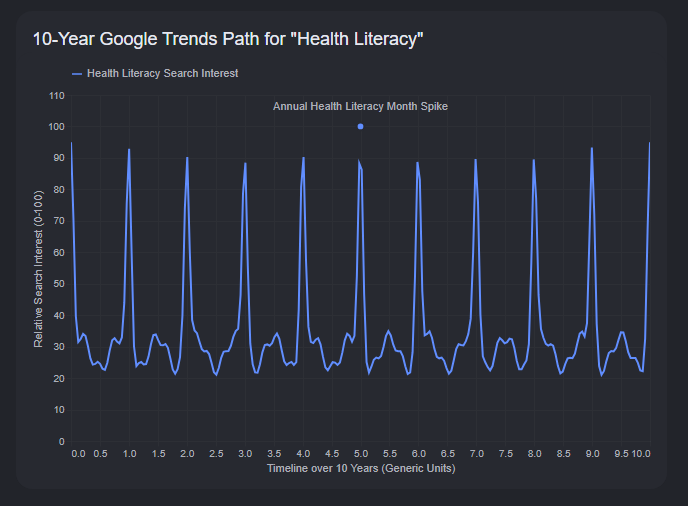
And the first place I thought I would look is just searches for the term “health literacy,” because I know, I had notes from when I started the show, health literacy as a term got searched about 10,000 times a month, but it would sometimes spike to as many as 100,000 times a month. And I’ll let you guess when that was.
Because I went ahead and updated those statistics. And sure enough, today, the exact phrase health literacy still ranks about 10,000 to 25,000 searches per month. And those big spikes, which happen during…Health Literacy Month, October every year. So good job, team! We get people coming to the yard every October and search for health literacy. So I’ll put that, the image is pretty fun because you can tell absolutely where the annual Health Literacy Month spike is on the chart. So I’ll put that in the show notes.
From there, I thought, well, what’s been going on in the health literacy field? And I found a paper from 2020 that had looked at some health literacy research trends for the five years prior. And they found that mental health was the most active research field in the five years prior to COVID. Then COVID comes. And I did not find a paper for the last like six-ish years of research activity. If you know of one, send it to me. So I went ahead and asked Google’s AI, “what are the top three research areas in health literacy research,” just to see what it would say.
And it said digital health literacy, organizational health literacy, and chronic disease management and health literacy. So I thought,
yeah, it’s AI, take it with a grain of salt. So I went ahead and started poking around and seeing what I could see about those three areas. So I can’t confirm if they’re the top research output areas, but I think we could all agree that they are active research areas since COVID.
For example, with digital health literacy, quite a number of studies have come out the last six years using the eHealth Literacy Scale, which is called eHEALS. And I would not be surprised if with AI rampaging around, we’re going to see more studies using the eHealth Literacy Scale for digital health literacy. And I hope that that attention stays there, because there’s a whole lot for us to learn and be doing in the digital health literacy space, especially with AI.
The next, I guess, popular topic: organizational health literacy. Again, not a big surprise here with Healthy People 2030 coming out and the big shift being toward the definition of organizational health literacy. You listen to this show, you know that the organizational definition was added to the individual definition for many reasons, And a lot of us are very excited about it, had been campaigning for changes to the definition for a long time, because there are so many limitations to just treating health literacy like it’s an individual skill, or it’s a fixed trait, or it’s just some sort of capacity that inheres inside an individual. The organizational definition really puts responsibility on organizations and their professionals in them to be thoughtful and intentional and responsive in how they are communicating with patients as individuals and as groups.
Then the chronic disease management and health literacy. Again, not a big surprise here. I was part of a community of practice from the World Health Organization run by Richard Osborne just before COVID. And so when I saw that pop up as one of the top topics, I was like, yeah, okay, that makes sense.
But then I noticed something interesting having to do with organizational health literacy. Maybe there’s a little bit more room in chronic disease management research in health literacy, for the new definition. For organizational health literacy. Because the papers I was seeing most recently are still relying pretty heavily on just the individual concepts of health literacy. Health literacy being a skill, a trait, some sort of fixed capacity.
Here’s why that’s important. You know, if you’ve listened to this show long enough, that there’s really good reasons to think about the kinds of skills that an individual has, that you want to support, when it comes to health literacy. You also know when you go too far in that direction, it can start sounding like you’re blaming people for the spot that they’re in in terms of their health.
For example, I don’t want to cite any papers, but when we see phrases that are like people with high health literacy are associated with all of these better health behaviors, or all of these better health outcomes, can start to sound like. people with low health literacy are just not doing a good enough job. Like if only they had paid attention in third grade reading class, they wouldn’t be in this spot.
So that’s where organizational health literacy comes in. To try to remind us like, look: this is an interaction between people and texts in organizational contexts where they don’t have a whole lot of power. And the professionals who do have a lot of power have the responsibility for doing as good a job as they can for shaping their communication to the people that they’re talking to.
So I thought it would be fun to wrap up this episode with a few things that you might want to keep in mind if it starts to sound like we’re over indexing a little bit on the individual here. Let’s bring the organizational back into the picture.
I’m going to give you four health literacy tips for the next text you have to make if you’re writing something that people have to read, or the next conversation you have to have if you’re face-to-face with people or via telehealth. These four things are going to help you in both of those cases.
1. All right, first of all, tie into what people are already doing. That means you’ve got to find out what they’re already doing when it comes to their health. What are they already watching? What are they already reading? What are they already listening to? What are they already writing and creating? What are they already sharing with others and with AI when it comes to their health?
2. Two, show them how much of what you want them to do they are already doing. So they are already being active with their health. They are already doing their best to lead a healthy lifestyle. They already are doing their best to take care of their family’s health as well. Remind them how much they’re doing right, and how much that overlaps with what you are asking them to do or teaching them about.
3. Third, go ahead and list out the pros and cons for staying where they are and keeping the status quo. And then pros and cons for making a change in the direction that you are suggesting. Pros and cons for both.
4. And then fourth, let them know how to take the next step, the next smallest step toward change, if they’re interested. If you’d like more help and tips like this, go ahead and get in touch with me. Visit healthcommunicationpartners.com. And thank you again for making this our ninth podcast anniversary!
This has been 10 Minutes to Better Patient Communication from Health Communication Partners. Audio engineering and music from Joe Liebel. Additional music from Alexis Rounds. Thanks for listening to 10 Minutes to Better Patient Communication from Health Communication Partners, LLC. Find us at healthcommunicationpartners.com.
